Introduction to Thomas Tuchel
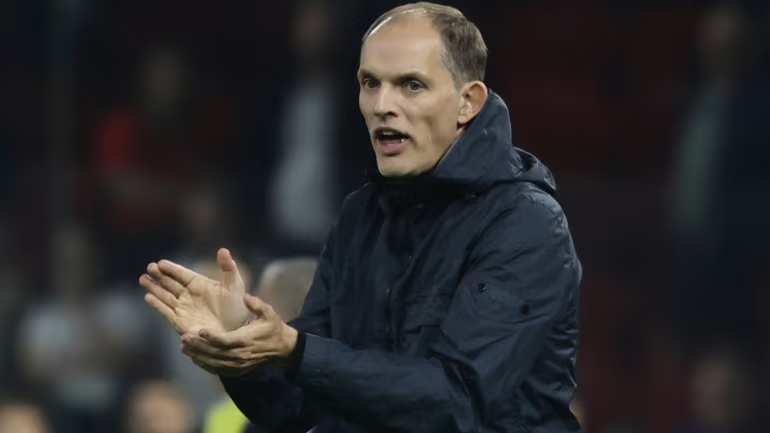
When discussing modern football’s most innovative managers, Thomas Tuchel immediately comes to mind. Known for his tactical acumen, meticulous preparation, and ability to transform teams almost instantly, Tuchel has carved out a niche as one of Europe’s elite managers. Born on August 29, 1973, in Krumbach, Germany, Tuchel’s journey in football began not on the grand stages of Bundesliga or Premier League but through grassroots coaching, emphasizing intelligence and adaptability from an early age. His style reflects his personality: detail-oriented, analytical, and demanding.
Thomas Tuchel’s rise in football management mirrors his philosophy on the pitch. He is not just a coach but a strategist, someone who studies opponents exhaustively and prepares his team for multiple tactical scenarios. He has consistently showcased the ability to revitalize clubs and elevate players’ performances, earning respect in a field crowded with managerial talents. From Mainz 05 to Chelsea, Thomas Tuchel’s trajectory is a testament to his commitment to innovation and a modern, flexible approach to football management.
Perhaps one of Thomas Tuchel’s defining characteristics is his intellectual approach to football. Unlike some managers who rely on intuition or past glories, Tuchel meticulously plans every match, incorporating data, psychological preparation, and player-specific tactics. His methods sometimes provoke debate, particularly when contrasting his results with the personalities in his squad, but few can question the impact of his work. He blends German discipline with modern football creativity, offering teams both structure and freedom—a rare combination in contemporary football.
Lastly, Thomas Tuchel’s story is also a narrative about resilience. Despite setbacks, including unexpected managerial exits and challenging stints at clubs, he has consistently bounced back, proving his methods work in various leagues and circumstances. This adaptability is crucial in today’s football, where pressures are immense, and expectations are sky-high.
Early Career and Rise at Mainz 05
Thomas Tuchel began his managerial career in the shadows of German football, taking charge of youth teams before earning his first major role at Mainz 05 in 2009. At Mainz, Tuchel inherited a modest Bundesliga side and immediately demonstrated his potential by instilling a philosophy focused on possession, high pressing, and tactical flexibility. Despite limited resources, he led Mainz to impressive mid-table finishes, showcasing his ability to maximize talent and instill a coherent system.
Thomas Tuchel’s approach at Mainz was revolutionary for a club of its size. He emphasized a fluid 4-2-3-1 system that could quickly transition between defensive solidity and attacking creativity. Players under his guidance often displayed newfound confidence, tactical intelligence, and positional awareness. He prioritized youth development and was known for trusting emerging talents, providing them with responsibility and a clear tactical identity. This hands-on approach helped Mainz punch above its weight in the Bundesliga.
Moreover, Thomas Tuchel’s early career highlighted his adaptability. He frequently adjusted his formations mid-game, a skill that would become a hallmark of his later work. Mainz was not a club with the budget to dominate opponents on sheer talent alone, yet Thomas Tuchel’s meticulous planning allowed them to compete against far wealthier clubs, earning admiration from fans and pundits alike.
By the time Tuchel left Mainz in 2014, he had already established a reputation as a modern, cerebral coach capable of transforming teams. His success at Mainz also served as a stepping stone, paving the way for his high-profile move to Borussia Dortmund, where his tactical brilliance would reach a broader audience.
Borussia Dortmund: Tactical Brilliance and European Recognition
In 2015, Thomas Tuchel took the reins at Borussia Dortmund, a club renowned for its attacking football and passionate fanbase. Dortmund was recovering from a period of inconsistency, and Tuchel’s arrival brought renewed energy and tactical sophistication. Unlike his predecessor, Jürgen Klopp, Tuchel’s style was more structured yet equally intense, emphasizing pressing, ball circulation, and positional fluidity.
At Dortmund, Thomas Tuchel achieved remarkable domestic success, guiding the team to a DFB-Pokal victory in 2017 and consistently competing for Bundesliga titles. His tenure was defined by a relentless pursuit of efficiency, both in attack and defense. He deployed various formations, from the traditional 4-2-3-1 to more experimental 3-4-3 systems, tailoring his approach to opponents while maintaining a cohesive identity. The results were impressive: Dortmund not only won matches but did so with style, demonstrating Tuchel’s ability to blend pragmatism with aesthetics.
Tuchel’s Dortmund also became a breeding ground for talent. Players like Ousmane Dembélé, Christian Pulisic, and Marco Reus flourished under his guidance, learning to adapt to multiple roles and responsibilities on the pitch. His emphasis on tactical intelligence meant that players were not only skilled but also smart in their decision-making, a critical differentiator in high-level football.
However, Tuchel’s time at Dortmund was not without challenges. His perfectionist nature sometimes clashed with players and club management, leading to tension despite on-field success. In 2017, Tuchel parted ways with Dortmund, but by then, he had cemented his reputation as a top-tier manager capable of succeeding under pressure and transforming ambitious clubs into formidable competitors in both domestic and European competitions.
Paris Saint-Germain: European Ambitions Realized
Thomas Tuchel’s next major challenge came in 2018 when he was appointed manager of Paris Saint-Germain (PSG). At PSG, expectations were monumental: win Ligue 1, dominate domestic cups, and finally break through in the UEFA Champions League. Tuchel’s tenure at PSG marked a shift in his career, as he was now managing a squad filled with world-class stars, including Neymar, Kylian Mbappé, and Ángel Di María.
Tuchel quickly implemented a system focused on controlling possession while exploiting the pace and skill of his attacking stars. He often rotated formations between 4-3-3, 4-2-3-1, and 3-4-3, demonstrating his tactical versatility. His PSG side was aggressive in pressing and fluid in attack, emphasizing quick transitions and exploiting space behind defensive lines. This approach not only secured domestic dominance but also advanced PSG to their first-ever Champions League final in 2020, where they narrowly lost to Bayern Munich.
One of Tuchel’s most notable achievements at PSG was his ability to manage star egos without compromising the team’s tactical cohesion. Balancing superstars is notoriously difficult, yet Tuchel found ways to make players feel valued while keeping them accountable to his tactical demands. His communication skills and strategic rotations were crucial in maintaining harmony in a high-pressure environment.
Despite his successes, Tuchel faced scrutiny when Champions League glory remained elusive. Internal dynamics, media pressure, and occasional tactical rigidity led to a parting of ways in December 2020. Yet, his PSG tenure remains a highlight in his career, showcasing his ability to succeed with elite players while making significant strides on Europe’s biggest stage.
Chelsea: Premier League Triumphs and Tactical Flexibility
Thomas Tuchel’s reputation earned him a high-profile move to Chelsea FC in January 2021. Chelsea was struggling under Frank Lampard, and Tuchel’s arrival marked an immediate transformation. Within months, he guided Chelsea to the UEFA Champions League title in 2021, defeating Manchester City in a tactically masterful final. This success cemented his reputation as one of the world’s top managers.
Tuchel’s Chelsea was defined by tactical discipline, defensive solidity, and a structured attacking approach. He implemented a flexible 3-4-2-1 formation that allowed Chelsea to transition seamlessly between defensive rigidity and offensive fluidity. Players like N’Golo Kanté, Mason Mount, and Romelu Lukaku thrived under his guidance, with Tuchel’s emphasis on positioning and spatial awareness enhancing their natural abilities.
Beyond tactics, Tuchel’s man-management was pivotal. He quickly gained the trust of the squad, instilling confidence in younger players while ensuring experienced stars maintained focus. His ability to communicate clearly, coupled with strategic adaptability, allowed Chelsea to compete on multiple fronts, including domestic league and European competitions.
However, Tuchel’s tenure at Chelsea also underscored the volatility of modern football management. Despite impressive results, off-field dynamics and ownership expectations eventually led to his departure in 2022. Even so, Tuchel’s impact on Chelsea is undeniable—his tactical intelligence, adaptability, and winning mentality left a lasting legacy.
Tuchel’s Tactical Philosophy: Innovation and Adaptability
Thomas Tuchel’s coaching philosophy is a blend of structure, creativity, and psychological insight. He values flexibility, often tailoring his formations and strategies to opponents while ensuring his team maintains a recognizable identity. Unlike some managers who adhere rigidly to one system, Tuchel’s adaptability is one of his greatest strengths.
Defensively, Tuchel emphasizes high pressing, compact lines, and anticipation. Offensively, he encourages fluid movement, quick transitions, and exploiting space. This dual focus allows his teams to control matches, dictate tempo, and adapt mid-game if necessary. He also emphasizes player intelligence, expecting individuals to read the game and make decisions independently—an approach that empowers stars while improving collective performance.
Another hallmark of Tuchel’s philosophy is psychological preparation. He invests heavily in understanding his players’ personalities, strengths, and weaknesses, ensuring his tactical plans align with their mental and emotional state. This combination of analytical precision and human understanding makes him a modern football innovator, capable of transforming clubs in short periods.
Finally, Thomas Tuchel’s attention to detail and relentless pursuit of improvement are evident in every team he manages. Whether at Mainz, Dortmund, PSG, or Chelsea, his methods consistently push players to evolve, fostering environments where tactical intelligence and performance excellence are paramount.
Conclusion:
Thomas Tuchel’s legacy in football is still evolving, but his impact is already profound. He represents a new breed of manager: intelligent, adaptable, and fearless in implementing tactical innovation. His ability to succeed across leagues, manage elite players, and deliver European success distinguishes him from many contemporaries.
Looking forward, Tuchel remains a sought-after figure in world football. His reputation ensures opportunities with top European clubs, and his methods suggest he will continue to shape the game’s tactical landscape. Whether he returns to the Premier League, Bundesliga, or another top league, Tuchel’s influence on modern football philosophy is undeniable.
Ultimately, Tuchel’s career serves as a blueprint for aspiring managers: combine tactical intelligence, psychological insight, and adaptability, and success will follow. His journey also reminds fans and players alike that football is as much about strategy and planning as it is about talent—a lesson Thomas Tuchel has mastered like few others.