McDonald’s Pizza
Introduction to McDonald’s Pizza
When you hear the words McDonald’s pizza, it almost sounds like an internet myth—something that shouldn’t exist but somehow does. McDonald’s is the undisputed king of burgers and fries, a brand synonymous with the Big Mac, golden arches, and lightning-fast service. Pizza, on the other hand, belongs to a completely different fast-food universe dominated by brands like Domino’s and Pizza Hut. Yet, at one point in history, McDonald’s genuinely tried to conquer the pizza market.
This wasn’t a random or half-hearted attempt. McDonald’s pizza was a serious experiment backed by research, operational changes, and even specially designed kitchen equipment. For a brief moment, it seemed like the fast-food giant might rewrite the pizza playbook. But as history shows, things didn’t go exactly as planned.
In this article, we’ll take a deep dive into the story of McDonald’s pizza—why it was created, how it worked, why it failed, and whether it might ever make a comeback. If you’ve ever wondered why McDonald’s doesn’t sell pizza today, you’re about to get the full story.
The Origins of McDonald’s Pizza
The idea of McDonald’s pizza began in the late 1980s and early 1990s, a time when the company was aggressively experimenting with menu diversification. McDonald’s was already a global powerhouse, but it wanted to expand beyond burgers. The leadership believed that expanding the menu could increase customer visits and compete more directly with full-service restaurants.
At the time, pizza was a booming industry in the United States. Delivery chains were growing rapidly, and pizza had become a go-to family meal. McDonald’s executives saw an opportunity: what if families could grab pizza quickly without waiting for delivery? Better yet, what if they could enjoy it in the familiar, family-friendly environment of a McDonald’s restaurant?
Initially, McDonald’s tested smaller, personal-sized pizzas called “McPizza.” These were designed to appeal to individual customers rather than large families. The idea was simple—give customers another reason to visit McDonald’s, especially during dinner hours when burger sales were typically slower.
However, the experiment quickly expanded beyond personal pizzas. Some locations began offering full-sized pizzas in an attempt to compete directly with established pizza chains. This was a bold move, and for a moment, it looked like McDonald’s might disrupt the pizza market in the same way it had revolutionized fast food.
What McDonald’s Pizza Actually Looked Like
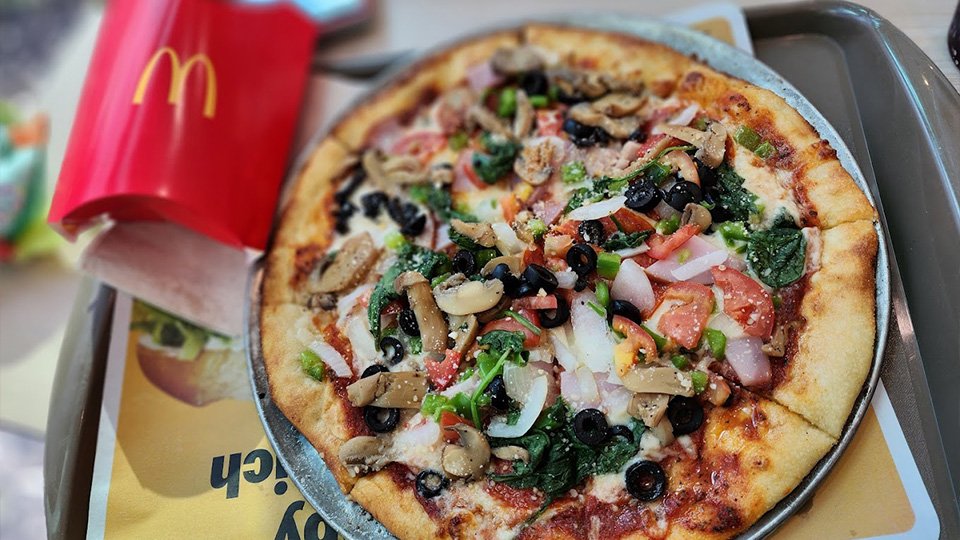
For those who never experienced it, McDonald’s pizza wasn’t just a novelty item. It was a legitimate pizza product made with traditional ingredients—dough, tomato sauce, cheese, and various toppings. Customers could choose from options like pepperoni, sausage, and plain cheese, similar to what you’d find at major pizza chains.
The personal pizzas were compact and served in a box, making them easy to eat in-store or take to go. The larger pizzas were designed for sharing and came in standard pizza boxes. McDonald’s even invested in special high-speed ovens to cook the pizzas faster than traditional pizza ovens.
One thing that stood out about McDonald’s pizza was its taste. Many customers who tried it claim that it was surprisingly good. It wasn’t gourmet, but it was solid—comparable to mid-tier pizza chains. The crust had a slightly different texture than most competitors, partly because of the specialized ovens designed to speed up cooking time.
Presentation-wise, it felt unmistakably McDonald’s. The packaging, branding, and overall experience aligned with the company’s fast-food identity. Yet at the same time, pizza felt slightly out of place on a menu dominated by burgers and fries.
Why McDonald’s Pizza Struggled
On paper, McDonald’s pizza seemed like a smart expansion. In reality, it clashed with the company’s core strength: speed. McDonald’s built its empire on efficiency. Customers expect their meals in minutes, not 10 to 15 minutes.
Pizza, even with specialized ovens, simply took longer to prepare. This created bottlenecks in the kitchen and frustrated customers who were used to near-instant service. During peak hours, adding pizza orders slowed down operations for everyone.
Another major challenge was logistics. Making pizza required additional equipment, ingredients, and training. Kitchens had to allocate space for ovens and prep areas, which wasn’t easy in restaurants already optimized for burger production. The added complexity disrupted the streamlined system that made McDonald’s so successful.
Then there was the competition. Established pizza chains had already mastered delivery and large family orders. McDonald’s struggled to match their efficiency in that category. Customers ordering pizza often preferred the convenience of delivery rather than dining in or driving through.
Ultimately, McDonald’s pizza wasn’t necessarily a bad product—it just didn’t align with the brand’s operational model.
Customer Reactions and Cult Following
Interestingly, despite its eventual failure, McDonald’s pizza developed something of a cult following. Many people who tried it remember it fondly. Online forums and social media threads occasionally light up with nostalgic discussions about the “McPizza.”
Some customers appreciated having a non-burger option, especially families with diverse tastes. Parents could order burgers for some kids and pizza for others. It added flexibility to group dining experiences.
The novelty factor also played a role. There was something amusing and intriguing about ordering pizza at McDonald’s. It felt unexpected, almost rebellious against fast-food norms.
Even years after most locations discontinued the item, rumors circulated that a few McDonald’s restaurants still served pizza. These stories only fueled the mystique and nostalgia surrounding McDonald’s pizza.
Lessons McDonald’s Learned from the Pizza Experiment
The McDonald’s pizza experiment wasn’t a total loss. In fact, it provided valuable lessons about brand identity and operational focus. McDonald’s realized that its strength wasn’t in offering everything—it was in perfecting a specific type of fast food.
The company shifted its strategy toward refining its core menu rather than expanding into unrelated categories. Instead of competing directly with pizza chains, McDonald’s focused on improving burgers, chicken items, breakfast offerings, and beverages.
Another key takeaway was the importance of kitchen efficiency. The pizza experiment highlighted how sensitive the McDonald’s system is to added complexity. Even small operational changes can disrupt service speed and profitability.
In many ways, McDonald’s pizza became a case study in business schools. It’s often cited as an example of how even massive corporations can struggle when they move too far from their core competency.
Could McDonald’s Pizza Ever Return?
With today’s advances in kitchen technology and automation, some wonder whether McDonald’s pizza could make a comeback. Modern high-speed ovens are far more efficient than those used in the 1990s. Digital ordering systems could also help manage longer preparation times.
Additionally, consumer tastes have evolved. Fast-casual dining and customizable menu options are more popular than ever. A reimagined McDonald’s pizza—perhaps as a limited-time offer—could generate significant buzz.
However, there are still major challenges. McDonald’s drive-thru business is stronger than ever, and pizza remains a slower product compared to burgers and fries. Introducing it again would require careful planning to avoid operational slowdowns.
If McDonald’s were to reintroduce pizza, it would likely be in a streamlined format—possibly as a personal-sized item designed for quick preparation. Whether or not that will happen remains uncertain, but the idea continues to intrigue fans.
The Legacy of McDonald’s Pizza
In the grand history of McDonald’s, pizza may seem like a footnote. Yet it represents something bigger—the company’s willingness to experiment and take risks. Not every innovation succeeds, but each one contributes to the brand’s evolution.
McDonald’s pizza reminds us that even industry giants must carefully balance innovation with identity. Straying too far from core strengths can create operational friction, even if the product itself is good.
Today, McDonald’s has refocused on what it does best. The menu is more streamlined, service is faster, and the brand remains dominant in its category. But for those who remember it, McDonald’s pizza holds a special place in fast-food history.
It’s a story of ambition, experimentation, and the delicate art of knowing when to pivot. And who knows? In the world of fast food, comebacks aren’t impossible. Until then, McDonald’s pizza remains one of the most fascinating “what if” stories in restaurant history.
Conclusion:
The story of McDonald’s pizza isn’t about failure—it’s about strategy. It’s about understanding your brand, your strengths, and your customers. While the product may not have survived, the lessons certainly did.
For fans who still dream about ordering a slice under the golden arches, the nostalgia is real. And sometimes, that nostalgia is what keeps the legend alive.
Whether it returns or stays a memory, McDonald’s pizza will always be one of the most interesting chapters in fast-food experimentation.
About the Author